Mark Hearld's book (which I suspect will be the first of many as he is so amazingly prolific) is full of good things, an abundance of paintings, pottery, linocuts, woodcuts and collages of brightness and charm, many having a look of freedom and looseness in the execution (like the forces of nature such as wind and rain), although other pieces are of a much more controlled and arranged form. His pictures sometimes look deceptively simplistic, yet when you look further more and more impressive details come into view.
Friday, 25 October 2013
Mark Hearld's Work Book: A Delightful World of Nature By A Modern British Artist
This lavish, full-colour book packed with the work of Yorkshire artist Mark Hearld is a feast for the eyes and full of images to inspire one to get busy with the paints. I first heard of Mark Hearld about three years ago or so and instantly was attracted to his work, and this book was a much desired Christmas present last year, and the first book I read this year. At the time I found out about his art I quickly discovered some other contemporary artists and for me it was a change to actually admire artists who were alive, as I'd always only been interested in centuries old paintings and artists long gone and had a dislike for most modern art, but this is modern art of a very different type, for this is art inspired by nature and a certain kind of folk art cosiness, not (for me) the scary and incomprehensible modern art of an abstract and cold, hard style with obscure meaning that I was forced to learn a bit about in college. In more recent years I discovered how limited my art education had been concerning certain times and movements and have tried to make up for it somewhat. So much of what I had to study I had a strong distaste for, which is a shame for, as unlike the views of some, I believe art should be beautiful, or at least attractive. I want nothing to do with ugliness in artistic creations, there is enough ugliness in modern society without adding to it, we need good things.
Mark Hearld's book (which I suspect will be the first of many as he is so amazingly prolific) is full of good things, an abundance of paintings, pottery, linocuts, woodcuts and collages of brightness and charm, many having a look of freedom and looseness in the execution (like the forces of nature such as wind and rain), although other pieces are of a much more controlled and arranged form. His pictures sometimes look deceptively simplistic, yet when you look further more and more impressive details come into view.
I heartily recommend this book to anyone who likes animal and nature-inspired art or mid-century British art, which is the main inspiration of Mark Hearld. I do hope a workbook volume two will be published in the near future.
Here are two wonderful videos about Mark Hearld's work:
Mark Hearld's book (which I suspect will be the first of many as he is so amazingly prolific) is full of good things, an abundance of paintings, pottery, linocuts, woodcuts and collages of brightness and charm, many having a look of freedom and looseness in the execution (like the forces of nature such as wind and rain), although other pieces are of a much more controlled and arranged form. His pictures sometimes look deceptively simplistic, yet when you look further more and more impressive details come into view.
Friday, 4 October 2013
Forest's Robe: Autumn Verses
Forest's Robe- Penhaligon's Scented Treasury Of Autumn Verse And Prose, edited by Sheila Pickles, is a lovely little book that I've had in my collection for quite a few years. It is one of those pretty little hardcover books full of old poems, prose and beautiful paintings, this one being all related to Autumn. Evocative titles of pieces include: A Mellow Afternoon, Autumnal, The Hayloft, Apple-Picking, The Plough, Autumn Fires, Harvest Time, Wild Plum Jam, Through the Woods, October, Michaelmas Daisies, Gathering Leaves, Apple Harvest...
The book is indeed scented, after all those years that beautiful soft scent is still there. Having a very sensitive nose and exceptionally keen sense of smell, I usually cannot abide perfume, but this scent is so lovely that it does not irritate, it is a comforting scent. Here is the description in the back of the book:
"Penhaligon's autumn pot-pourri is called Forest's Robe, composed of the bark, oakmoss, pine cones and other treasures of the forest floor.
Oakmoss is gathered from the old oak forests of Eastern Europe and buckthorn bark comes from the great trees of North America. These are mixed with cypress cones, bay and uva ursi leaves, bakuli nuts from Malaysia, alder seed pods and cassurina cones from the Mediterranean.
With its natural blend of wood and moss, Forest's Robe has a beguiling green scent which perfumes the endpapers of this book and perfectly captures the spirit of autumn."
Autumn is my favourite season of the year; its special, subtle, quieter charms can delight more than other seasons, although there is boldness in the bright turning of leaves and vibrant flowers that demand to be noticed.
Who could resist a fresh, sweet and fragrant apple?
Here is an excerpt, from 'A Year in a Lancashire Garden' by Henry A. Bright, 1891:
APPLE HARVEST
"Our Apple harvest has been over for nearly a fortnight; but how pleasant the orchard was while it lasted, and how pleasant the seat in the corner by the Limes, whence we see the distant spire on the green wooded slopes. The grey, gnarled old apple-trees have, for the most part, done well. The Ribston Pippins are especially fine, and so is an apple, which we believe to be the King of the Pippins.....Indeed all eating apples, with but few exceptions, are best when freshly gathered, or, better still, when, on some clear soft day. they have just fallen on the grass, and lie there, warmed by the rays of the autumn sun."
Monday, 2 September 2013
Country Books
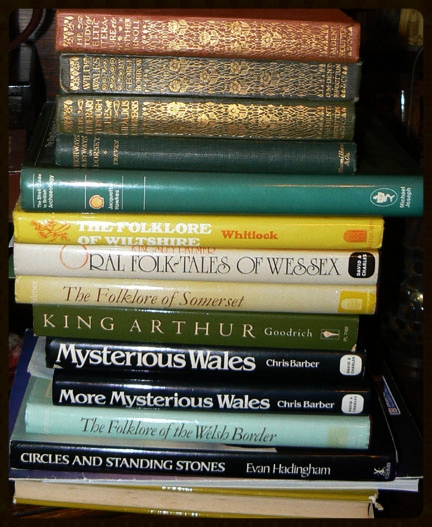
Recently I've been more involved with my music blog and devoting some time to it, but here are some of my nice country and folklore books to look at anyway, until I post something bookish more in depth. I believe in arranging books together by subjects and strongly object to arranging them by colour, but it just so happened that so many of these are green and yellow and don't they look pretty together?
Saturday, 17 August 2013
Reading Plans Going Awry
I am usually off on one tangent or another, suddenly becoming mildly obsessed with a particular subject and wanting to read what I can find on it and usually buying several books on the subject. But reading plans can change as swiftly as they come, a moody or changeable reader (or one with too many interests, like myself) can find themselves abandoning the settled plan and instead of diligently setting forth on an in-depth study of say, Medieval architecture, Arthurian legends, or the Pre-Raphaelites or whatever; one can end up reading something quite different and often much less intellectual.
I've recently read of other readers lately who have tried to stick with a reading plan and ended up leaving it. I suppose when we set ourselves a reading list to follow, it becomes a bit like a task and we don't like to feel tied down to forcing ourselves to read something, especially when that changeableness comes on.
The summer before last, I wanted to dip my toe into British archaeology, make a light study of chalk hill figures, stone circles, and continue reading more folklore and country books. This all tied in with some paintings I was doing and an idea for a music project. I had previously read John Aubrey's Natural History of Wiltshire and Stuart Piggott's books on William Stukeley and Antiquaries and other books over time. This was the stack of books I meant to read:
I even bought some more books to go along with these, but apart from the West Country folklore books, I didn't get very far and ended up reading very different books. This year one plan of mine was to read about the bohemian Bloomsbury set, particularly Vanessa Bell, who I think was an extremely interesting artistic woman. This is my collection of Bloomsbury and related titles, which I will go into in more depth at a later time:
I've recently read of other readers lately who have tried to stick with a reading plan and ended up leaving it. I suppose when we set ourselves a reading list to follow, it becomes a bit like a task and we don't like to feel tied down to forcing ourselves to read something, especially when that changeableness comes on.
The summer before last, I wanted to dip my toe into British archaeology, make a light study of chalk hill figures, stone circles, and continue reading more folklore and country books. This all tied in with some paintings I was doing and an idea for a music project. I had previously read John Aubrey's Natural History of Wiltshire and Stuart Piggott's books on William Stukeley and Antiquaries and other books over time. This was the stack of books I meant to read:
I even bought some more books to go along with these, but apart from the West Country folklore books, I didn't get very far and ended up reading very different books. This year one plan of mine was to read about the bohemian Bloomsbury set, particularly Vanessa Bell, who I think was an extremely interesting artistic woman. This is my collection of Bloomsbury and related titles, which I will go into in more depth at a later time:
I had previously read 'Bloomsbury At Home' by Pamela Todd, and last summer the utterly wonderful 'Romantic Moderns' by Alexandra Harris; but apart from browsing through the other books, I haven't even begun to read them! Most of my reading time this year has been in vintage fiction, and I've been getting through a lot more books this year than normal. But now at this time I am reading the wonderful 'Albion: A Guide To Legendary Britain' by Jennifer Westwood, which fits in with that earlier list, but I confess that I feel guilty that I have not been reading history as much as I should and feel a poor scholar for not having more discipline in continuing my personal studies of history; medieval history being a great interest to me. When I constantly see those shelves of books, so many of them still to read, I feel I've been too lazy. I get very excited over history books and one of my favourite bookish things to do is to explore the bibliographic sources in the back of books, which is very interesting and can set you off onto lots of other, older books on a subject.
So I am striving to be more scholarly in my reading, and while I don't promise to follow a set plan, I do intend to carry on with being more disciplined in getting a certain amount of history reading in. It has been fun to just wander and read lots of fun books too though (like vintage Puffins), and I will still do that.
I would be interested to hear of others and their view on reading plans, so do please comment.
(By the way, do visit my companion Music blog over here:
for some good music featured, if you like that sort of thing)
Tuesday, 6 August 2013
The Midnight Folk by John Masefield
This story is a delight, as we follow young Master Kay Harker on a fantastical jumble of adventures and alternate realities and to secret worlds (involving a search for lost treasure); where animals (and toys) talk and interact with Kay, people are not what they seem, and magical journeys occur. We clamber into hiding places and spy on wicked witches and scheming villains. Portraits speak and landscape paintings move. Poor Kay has much to endure with his beastly governess Sylvia Daisy (who obviously doesn't like children). The inside flap of the dustjacket gives this description of the tale within:
"Kay Harker lives in a big house with his governess, Jane the cook, Ellen the maid, and Nibbins the black cat. Nibbins is one of the family of the Midnight Folk. So too is Bitem the Fox, Blinky the Owl, Rat, Otter and a whole tribe of other friends, bears, dogs, rabbits, cats and horses, all of them Kay's toys. Kay is bent on discovering the long-lost Harker treasure. With the help of the Midnight Folk he makes nightly investigations into the mystery which lead him into all kinds of marvellous adventures. Sometimes Kay is convinced that he is dreaming, but at other times there is proof that his midnight wanderings in search of clues are no fantasy but actual fact."
Here is a passage from Kay's first night of adventures:
"Kay slipped on his slippers and followed Nibbins into the little passage: Nibbins closed the door behind him and bolted it. "I'll lead the way," he said. "Mind the stairs: they're a bit worn; for the smugglers used to use these passages. But there's lots of light. Take my paw, as up we go." They went up some stairs in the thickness of the wall; then a panel slid up in front of them and they came out on to the top landing. Nibbins closed the panel behind them. It was dark night there on the landing, except for a little moonlight. The house was very still, but looking down over the banisters into the hall, Kay thought that he saw a shadow, wearing a ruff and a long sword, standing in the moonlight. The cuckoo-clock in the nursery struck twelve. "All the house is sound asleep," Nibbins said. "Jane and Ellen are in there in those two rooms. They little know what goes on among us midnight folk. Give us a hand with this ringbolt, will you?" In the oak planks of the floor there was a trap-door, which Kay had never seen before. Together they pulled it up: beneath was a ladder leading down to a passage brightly lit like the other...
There were seven old witches in tall black hats and long scarlet cloaks sitting round the table at a very good supper..."
Fortunately, as in the best books, the baddies are defeated and all turns out well and happy; which includes the arrival of the lovely Caroline Louisa, who we will hear more from in the next story, 'The Box of Delights.'
This book was a splendid read, sometimes there was so much going on that it could be bewildering, and I think that some of the terms and references might be difficult for younger readers today, unless they are very mature and well-read and read more old-fashioned books. The old-fashionedness of it is one of its great charms, and what drew me in to seek it out. This is a book that I simply didn't want to end.
Monday, 29 July 2013
A Rambling Miscellany Of Summery Verses and Pictures
As we are in the midst of summer, it seems a miscellany of summery verses gathered from various books and songs would be a lovely seasonal touch. Imagine being under a shady tree with a particularly fine picnic laid out, and of course, the temperature not too hot with a gentle breeze. Lose yourself in all this romantic imagery of nature in Summer.
"The word 'summer' comes from the Sanskrit asma, meaning 'half-year'. Like the year itself, summer is divided into seasons, low summer, midsummer, high summer. Low summer is scarcely more advanced than high spring because several species of migrant birds have only lately arrived, and the woods shine as they did in May. Midsummer is more spacious. From dawn till dusk the sun spans our waking hours and overlaps them with a long arc which George Meredith drew with a short line: 'This was a day that knew not age.' High summer bestows almost a surfeit of colour and scent, for the corn is yellowing, the chrysanthemums are flowering and the honeysuckle yields a second crop..." J.H.B. Peel, from Calvacade of Summer Riches
"A Brimstone butterfly drifted with the wind over the waving grasses, and settled on the shallow cup of a tall flower, John-go-to-bed-at-noon. The bright flowers were closing, for the sun was high. It paused for an instant only, and then fluttered over the hedge and was gone. Came a common white butterfly-a weed of the air, hated by the countrymen; yet part of summer's heart as it flickered like a strayed snowflake in the sunshine, passing the whorled spires of red-green sorrel and glazed petals of buttercup, living its brief hour among the scents and colours of summer.
Vibrating their sun-crisped wings with shrill hum, the hover-flies shot past: the wild bumble-bees sang to themselves as in a frenzy of labour for their ideal they took the pollen from the roses in the hedge; the cuckoos sent call after call of melody from the distant hazel coppice. The sound of summer was everywhere, the earth filled with swelling ecstasy-everything so green and alive, the waving grasses and the hawthorns; the green kingdom charged and surcharged with energy, from the wild strawberry to the mighty, sap-surfeited bole of the oak. Although so still, the vast earth was humming and vibrating, the crescendo of passion reached gradually while the sun swept nearer, day by day, the zenith of its curve." Henry Williamson, Meadow Grasses
Gather Meadowsweet For Its Invigorating Scent:
"Meadowsweet originally 'mead-sweet', takes its name from its use in flavouring honey-mead drinks. It is reported that the flowers boiled in wine and drunk to make the heart merry. The leaves and flowers far excel all other strewing herbs, for to deck up houses, to strew in chambers, halls and banquetting houses in the Summer time: for the smell thereof makes the heart merry, delightest the senses." Gerald, Herball 1597"Also used against fevers and malaria, meadowsweet contains a substance similar to aspirin. In the Highlands it is called Crios Chuchulainn, 'Cuchullain's belt' because the great Ulster hero revived himself by binding it around his waist." from, A Celtic Book of Days
"The high grasslands on a summer day have an idyllic quality. They are remote and quiet. They are green and kind to the eye. They are ease to the feet, the flowers have great variety and a new beauty, and the very pebbles among which they grow have a sparkle and show of colour...Take a little tent and remain in the quietness for a few days. It is magnificent to rise in the morning in such a place." Sir Frank Fraser Darling, The Highlands and Islands
Summer has spread a cool, green tent
Upon the bare poles of this tree;
Where 'tis joy to sit all day,
And hear the small birds' melody;
To see the sheep stand bolt upright,
Nibbling at grass almost their height.
How much I marvel now how men
Can waste their fleeting days in greed;
That one man should desire more gold
Than twenty men should truly need;
For is not this green tone more sweet
Than any chamber of the great?
W. H. Davies
"Is there any light quite like the June sun of the North and West? It takes trouble out of the world."
Sir Frank Fraser Darling (1903-1979) Island Days
SUMMERY VERSES in Scots from traditional Scottish folk songs
Oh the Gallowa' hills are covered with broom, Wi' heather bells, in bonnie bloom;
Wi' heather bells an rivers a', An I'll gang oot ower the hills to Gallowa'...
High up amang yon Hieland hills
There lives a bonnie maiden,
And she's gone oot ane fine summer's night
To watch all the soldiers paradin'....
Oh the summer time is come and the trees are sweetly bloomin'
And the wild mountain thyme grows amang the bloomin' heather...
Let us go lassie, go, tae the braes o' Balquhidder,
Whar the blueberries grow 'mang the bonnie Hielan' heather;
Whar the deer and the rae, lichtly bounding thegither,
Sport the lang summer day on the braes o' Balquhidder.
Noo the summer's in prime, wi' the flooers richly bloomin',
Wi' the wild mountain thyme a' the moorlan's perfumin';
Tae oor dear native scenes let us journey thegither,
Whar glad innocence reigns, 'mang the braes o' Balquhidder.
Robert Tannahill
Too quick despairer, wherefore wilt though go?
Soon will the high Midsummer pomps come on,
Soon will the musk carnations break and swell
Soon shall we have gold-dusted snapdragon,
Sweet William with its homely cottage-smell,
And stocks in fragrant blow;
Roses that down the alleys shine afar,
And open, jasmine-muffled lattices,
And groups under the dreaming garden-trees,
And the full moon, and the white evening star. (Matthew Arnold)
SUMMER, by John Clare
The oak's slow-opening leaf, of deepening hue,
Bespeaks the power of Summer once again;
While many a flower unfolds its charms to view,
To glad the entrance of his sultry reign.
Where peep the gaping speckled cuckoo-flowers,
Sweet is each rural scene she brings to pass;
Prizes to rambling school-boys' vacant hours,
Tracking wild searches through the meadow grass:
The meadow-sweet taunts high its showy wreath,
And sweet the quaking-grasses hide beneath.
Ah, 'barr'd from all that sweetens life below,
Another Summer still my eyes can see
Freed from the scorn and pilgrimage of woe,
To share the Seasons of Eternity.
"It was a bright morning in the early part of summer; the river had resumed its wonted banks, and a hot sun seemed to be pulling everything green and bushy up out of the earth, as if by strings. The Mole and Water Rat had been up since dawn, busy on matters connected with boats and the boating season; painting and varnishing, mending paddles, repairing cushions, hunting for missing boat-hooks, and so on..." Kenneth Grahame, The Wind in the Willows
Quite over-canopied with luscious wood-bine, With sweet musk-roses and with eglantine;
There sleeps Titania sometime of the night, Lull'd in these flowers with dances and delight....
William Shakespeare, A Midsummer Night's Dream
Paintings by: Samuel Palmer, Eric Ravilious, Tirzah Garwood, Charles Robinson, Inga Moore, Vanessa Bell, unknown, Inga Moore, Arthur Rackham, Helen Allingham, Stanley Spencer
Thursday, 25 July 2013
Discovering Old Bicycles
I came across a photo of this Shire Album book cover and think it looks an interesting, attractive little book.
Wednesday, 17 July 2013
The Isle of Skye: Armchair Travelling
A wise man once said: 'Skye is not a place but an intoxication.'
With others writing about their summer journeys and some doing that via armchair travelling, I thought a special destination (reluctantly only) via books would be in order now.
Let us now journey to The Isle of Skye. I've felt drawn to the Isle of Skye for many years, but haven't actually been there...yet; for I feel it in my bones that I will get there. I also was interested in it as Ian Anderson of Jethro Tull owned part of it and the Strathaird estate from the late 1970s to the mid-late 90s.
It takes very little to transport me to that Scottish island feeling, that sense of timelessness and the carefree state of mind that one has in that kind of wild surroundings. It could be the sound of the sea, a fiddle tune, the natural, delicate and varied colours of a woollen scarf, and the intense lure from distant ancestry. It has inspired my own music and painting, I've painted several landscapes, for sometimes one just needs to paint a mountain! Here is one of mine from years ago, using it as an idea for a logo for my Thistle Cottage Recordings musical cottage industry:
I've gathered a few books together from my shelves specifically about, or set in, the Isle of Skye. Shall we browse through the selection? There is 'Portrait of Skye And The Outer Hebrides' by W. Douglas Simpson, 'Skye & the Western Isles' by James & Deborah Penrith, 'Skye: The Island And It's Legends' by Otta Swire, and 'Old Skye Tales' by William Mackenzie. Then two mysteries with a Skye setting: "Wildfire At Midnight' by Mary Stewart (which I read last year), and 'Master of Morgana' by Allan Campbell McLean, which I began reading last night.
From the lone shieling on the misty island,
Mountains divide us, and a waste of seas;
Yet still the blood is strong, the heart is Highland,
And we, in dreams, behold the Hebrides.
" The Island of Skye-the 'Misty Isle' as it has long been called...is the largest but one of the Hebrides. Its main mass lies north-west and south-east, running out at its broad upper end into three long promontories of Trotternish, Vaternish, and Duirinish, divided from each other by Loch Snizort and Loch Dunvegan. Midway from the long western coast projects the squat mass of Minginish, flanked by Loch Bracadale and Loch Scavaig. Beyond the latter the bold headland of Strathaird is isolated by Loch Slapin and Loch Eishort from the long transverse butt of the island, known as Sleat and Strath, which in shape is uncommonly like a gigantic fish's tale. The island is 49 miles in length. It's breadth varies from 7 to 25 miles. But owing to the irregularity of the coastline, and the great number of fjord-like lochs, no part of the interior is as much as 5 miles from the sea. The total length of coastline is over 900 miles. Skye contains 690 square miles, most of which is moorland and mountain. Of the mountains, three main systems may be distinguished. The principal one is the grand group of the Cuillins, in the south-west, forming the base of Minginish. Without question these are the most magnificent of British mountains." (Portrait of Skye and the Outer Hebrides, W. Douglas Simpson, 1967)
There is much folklore, history, many books on Skye, and fiddle tunes, folksongs, folk bands from there or about there.
"Thanks to its stunning scenery, romantic associations and accessibility, Skye is the most visited of all the western islands and has been for more than a century, since the railroads and steamships of the Victorians brought the islands of the Inner Hebrides that much closer to the bursting cities of the mainland. There are some purists who insist that Skye is no longer an island, and that somehow it's not the same singing the Skye Boat Song while speeding over the bridge that has kinked it firmly to the mainland at Kyle of Lochalsh since 1995. (Skye & the Western Isles, Penrith, 2007).
From traditional Scottish Folk band Ossian, the tune 'The Sound of Sleat:
The 'Dun Ringill' video by Jethro Tull:
and Fish n' Sheep n' Rock n' Roll from 1987, about Ian Anderson's music and the salmon farm in Skye as well, which you can find easily.
The Corries with 'Skye Boat Song':
So we must gather our bags, not forgetting the Ordnance Survey map, sturdy walking boots, rain-proof jackets, some non-effective midge repellent, etc...and wend our way to the train station.
Thursday, 11 July 2013
The Folklore Of The Cotswolds
From my Interesting Book Covers series. I bought this many years ago on holiday, I think from the 15th Century Bookshop in Lewes, Sussex. It's an excellent volume in the Folklore Of The British Isles series by the great and legendary folklorist Katharine Briggs. The artwork is striking and very good, but no matter how many times I see the cover, that face is rather alarming!
Tuesday, 2 July 2013
Agatha Christie: A Reader's Companion
'Agatha Christie- A Reader's Companion,' is a MUST if you are an Agatha Christie admirer. It is a beautiful book and an absolute delight to browse through, being a compendium of all of her books and the date and synopsis of each story. The most exciting feature of this book is the photographs of the artwork of the original dustjackets.
Another guide that goes into more depth than this one (but without the striking pictures) is 'The New Bedside, Bathtub & Armchair Companion to Agatha Christie,' another Must Have for mystery readers.
I've been an Agatha Christie fan since the age of eleven, but unfortunately I don't have a record of all her books I read in the early days, as I only started making a reading record several years later. So, because there are so many titles, I sometimes wonder if I may have read a book in the past or not. I have read some favourites multiple times, but I'm sure I have many more to read, and I'm glad that I haven't read them all....yet!
Subscribe to:
Posts (Atom)